
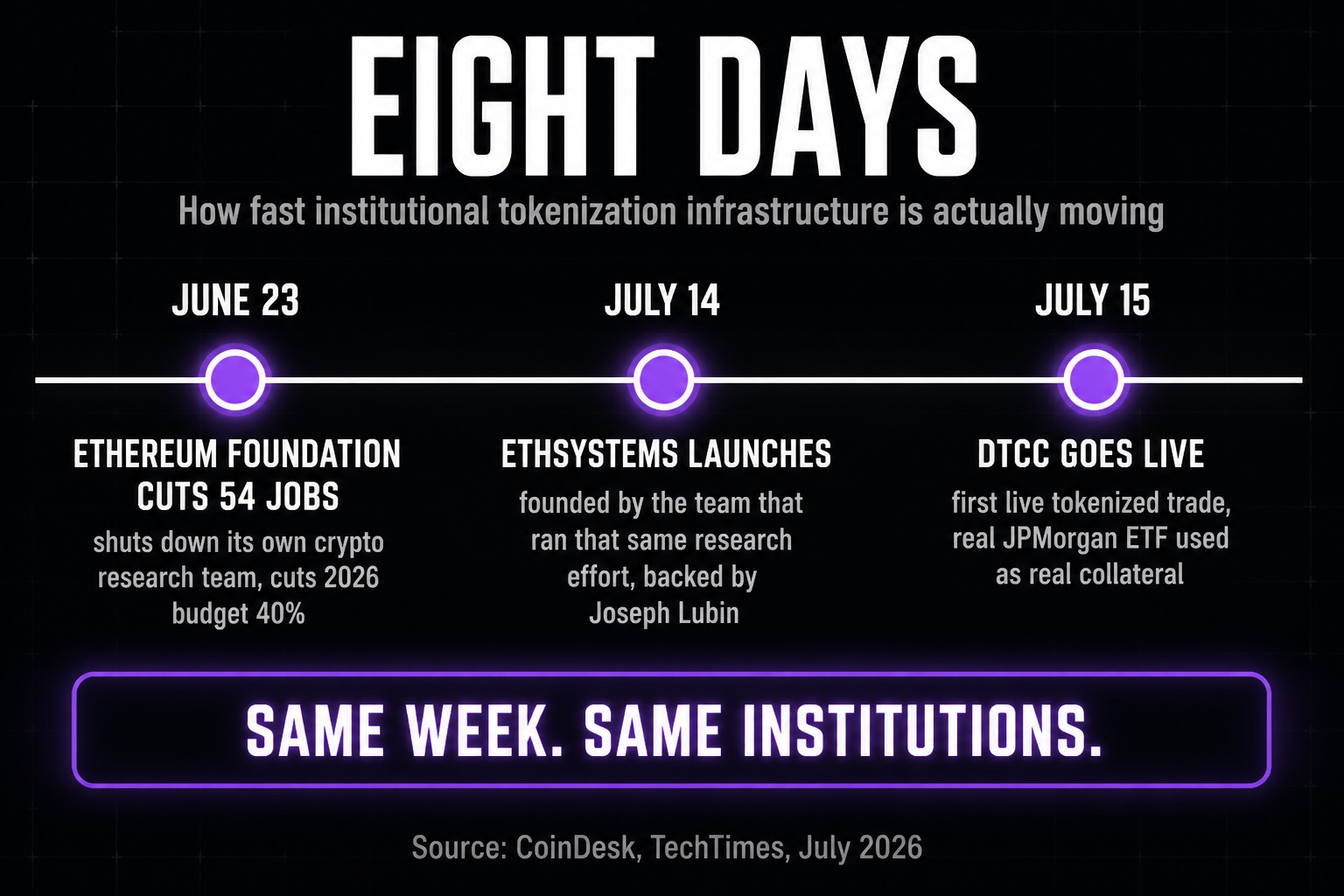
Three things happened inside eight days. On June 23, the Ethereum Foundation cut 54 jobs, roughly a fifth of its staff, slashed its 2026 budget by about 40 percent, and shut down its own applied cryptography research team. On July 14, three people from that team launched a for-profit company, backed by Ethereum co-founder Joseph Lubin, to sell the exact privacy technology banks need before they will trust a public blockchain with real trades. On July 15, DTCC, the institution that settles almost every US stock and bond trade, processed its first live production trades of tokenized securities, not a demo, not a plan, an actual JPMorgan ETF used as actual collateral against an actual CME Group margin call.
Read individually, these are three separate headlines. Read together, they are one story: the infrastructure for institutional tokenization is being assembled in real time, by serious people, funded by people with a direct financial stake in it working, for a specific and narrow list of customers. I want to walk through what actually happened in each piece, give it the credit it earns, and then be precise about who it was built for. This is the update to RWA Roast #17, where DTCC was still a plan.
What DTCC actually did on July 15
This is the update that matters most since I last covered DTCC in Roast #17. In May, the plan was limited production trades in July and a full launch in October. On July 15, DTCC processed the July part, live.
More than two dozen major institutions participated, including JPMorgan Chase, Goldman Sachs, BlackRock, and Vanguard. The transactions covered tokenized equities, ETFs, and Treasuries across collateral transfers, repo, margin movements, securities trades, and asset transfers. The two concrete examples worth knowing: JPMorgan converted its holdings of the Invesco QQQ Trust ETF into a tokenized form and used that tokenized position as collateral to satisfy a margin requirement with CME Group, and the SPDR S&P 500 ETF Trust, one of the largest ETFs in the world, was tokenized during the same event.
DTCC's approach is specifically not the "wrapper" model most crypto tokenized-stock products use, where a token merely tracks a price without carrying the legal rights of the underlying share. DTCC converts securities that are already held at its own depository into blockchain-based "digital twins" that retain the same legal ownership, dividend, and governance rights as the original. Some of Wednesday's transactions settled on Hyperledger Besu, others on Canton Network, a blockchain built specifically for regulated markets that lets institutions share data with approved counterparties while keeping it private from everyone else. Notably, none of it settled on public Ethereum. DTCC is safeguarding over $114 trillion in securities. It did not choose the most open chain available to it. It chose the ones built for privacy and permissioning first. If you want the mechanics of what DTCC built and why, the DTCC tokenization guide walks it, and the regulated venues where tokenized securities are meant to trade and settle in Europe are the subject of the EU DLT Pilot Regime guide.
Mark Wendland, CEO of Canton Strategic Holdings, gave the honest framing in an interview after the event: "I cannot understate the importance of a firm like DTC piloting and doing these real transactions given the role they play in U.S. financial markets." He also gave the necessary caveat in the same breath: "This validates that it's possible. It doesn't demonstrate that demand is there." That second sentence is worth sitting with. A successful pilot proves the plumbing works. It does not prove anyone outside this specific room wants to use it yet.
What EthSystems actually is, and why it exists right now
EthSystems was founded by Mo Jalil (CEO), Oskar Thoren, and Aaryamann Challani, the three people who built and ran the Ethereum Foundation's Institutional Privacy Task Force. Over the past year in that role, they met with hundreds of institutions, including central banks, and published a public body of open-source work: proof-of-concept systems for private bond issuance, compliance-first shielded pools for confidential stablecoin transfers, private cross-chain atomic swaps, and something called the Ethereum Privacy Map, a document tracking where privacy gaps exist across the entire stack. EthSystems is the commercial version of that work: workshops, proofs-of-concept, and custom systems for paying institutional clients, with specs kept public as they go.
Here is the context that makes this launch more than a routine startup announcement. EthSystems is the third organization to spin out of the Ethereum Foundation since late June, alongside a protocol research lab called Ethlabs and an institutional-engagement nonprofit called Ethereum Institutional. All three exist because the Foundation itself pulled back hard: the June 23 restructuring eliminated the unit called Privacy and Scaling Explorations, the team responsible for turning Ethereum's zero-knowledge research into shipped code, things like shielded-pool designs and anonymous credential systems used across the ecosystem. That team had no direct successor inside the Foundation. EthSystems, a for-profit company, is now the closest thing the Ethereum ecosystem has to a commercial home for that specific kind of work.
The actual technical problem, explained plainly
The core idea EthSystems sells is called selective disclosure: each party in a transaction sees only the information it is entitled to see, nothing more. The mechanism that makes this possible on a public blockchain is a zero-knowledge proof, a piece of cryptography that lets someone prove a statement is true, "this trade is valid," "this buyer passed KYC," without revealing the actual data behind it. In a normal Ethereum transaction, the sender, receiver, and amount are all visible to anyone. In a shielded transaction, that data is encrypted, and what gets recorded on-chain instead is a compact mathematical proof that the transaction followed the rules. Each authorized party then holds a "viewing key," a credential that decrypts only the specific transactions they are allowed to see. A regulator's viewing key might unlock a bank's full activity for an audit. A counterparty's viewing key unlocks only their own side of one trade.
EthSystems CEO Mo Jalil put the business case for this directly at launch: "No central bank, asset manager or government will run operations in full view of the world. For them, privacy isn't a feature. It is the requirement, and it is the difference between Ethereum holding billions today and running trillions tomorrow." Tom Lee, chairman of Bitmine, one of EthSystems' anchor backers, put a number on the ambition: "The next $100 trillion of assets won't migrate on-chain without it."
There is already a live, concrete example of the exact problem EthSystems is chasing. Earlier this month, the Swift banking network's own blockchain ledger went live with 17 major banks piloting 24/7 tokenized deposit payments. They built it on Hyperledger Besu, an Ethereum-compatible codebase, specifically because it let them keep the network permissioned. Seventeen serious banks looked at public Ethereum and chose a private version of it instead, because the privacy layer EthSystems is trying to sell did not exist yet. That is not a hypothetical customer. That is the exact gap, already visible in production, before EthSystems has signed a single one of them.
Who is actually funding this, and why that matters
EthSystems' anchor backers are Bitmine Immersion Technologies, Sharplink, and Joseph Lubin, with additional backing from SNZ and other Ethereum ecosystem investors. The funding amount was not disclosed in any source I could find, which is itself worth noting for a launch with this much press behind it.
Bitmine and Sharplink are not passive investors picking a promising startup. They are the two largest publicly traded Ethereum treasury companies, holding billions of dollars in ETH on behalf of public shareholders. Their own stock valuations move, in part, on how credible Ethereum looks as institutional infrastructure. Funding the company that is supposed to make Ethereum bank-safe is not a side bet for them, it is closer to funding their own thesis. That also means they are positioned to become EthSystems' first paying customers, which compresses the usual gap between a startup raising money and a startup finding demand. It is not evidence of anything improper. It is a detail worth knowing before treating the backing itself as proof of independent market demand.
As of this launch, EthSystems has a year of public technical work, a founding team with real institutional relationships, and no named paying client.
Now put the three pieces next to each other
DTCC just proved tokenized securities can move through real market infrastructure using chains built for permissioning and privacy. Seventeen Swift banks already chose that same kind of permissioned setup over public Ethereum for the identical reason. EthSystems exists specifically to close that gap on Ethereum itself. None of these three efforts, not the DTCC pilot, not the Swift pilot, not EthSystems' client list, includes anyone outside the world's largest financial institutions. The infrastructure is arriving fast, it is arriving for real, and it is arriving in the order a bank would need it. It is not arriving for a business trying to raise capital against a warehouse or a producing asset for the first time. That is the same pattern the $32 billion RWA teardown found from a different angle: on-chain real-world assets are mostly finance-on-chain, built for and used by the institutions that already own the pipes.
To be fair
Give this the credit it earns. A live trade at DTCC, using real collateral to satisfy a real margin call at a real clearinghouse, is a different order of event from a press release about future plans. A team with a year of shipped open-source cryptography work, walking straight into a gap the Ethereum Foundation itself just created by cutting its own research budget, is a legitimate and fast-moving response to a real problem, not vaporware. None of this is a story about anyone lying. It is a story about exactly who gets to walk through the door first, and how far that is from the read on tokenization most retail coverage sells.
The Scorecard
Scoring the institutional stack as a signal, not as a spectacle. The point of the score is the distance between how real and how fast this infrastructure is arriving, and how narrow the guest list still is. This is a judgment, not a verdict on DTCC or EthSystems, whose execution is genuinely strong.
| Category | Score | Notes |
|---|---|---|
| DTCC pilot: is it real | 9/10 | Live production trades July 15, 2026, real institutions, real collateral used against a real CME margin call. Not a plan, not a demo. |
| DTCC pilot: does it show demand | 3/10 | Per Canton Strategic Holdings' own CEO: "validates that it's possible," does not demonstrate demand exists beyond the pilot's own two dozen participants. |
| EthSystems: technical credibility | 8/10 | A year of public, shipped open-source cryptography work from the team that ran the Ethereum Foundation's own institutional privacy effort. |
| EthSystems: proof of paying demand | 2/10 | No named paying client as of launch. Funders and likely first customers are the same two companies. |
| Accessibility to a non-institutional issuer | 1/10 | Every participant across all three efforts (DTCC, Swift, EthSystems' target list) is a top-tier bank, asset manager, or clearinghouse. |
| Speed of institutional infrastructure build-out | 8/10 | Three material, dated events in eight days is a genuinely fast pace for this category. |
| Honesty of the "tokenization has arrived" framing in most coverage | 3/10 | True for the specific institutions involved. Presented in most coverage as broader than that. |
| Overall | 4/10 | Real, fast-moving, credible institutional infrastructure. Still being built exclusively for the biggest players in the room, with the funders and the future customers frequently being the same people. |
The 4 is not a shot at DTCC or EthSystems, whose execution I would score much higher on its own terms. It is a score for the reading that most coverage hangs on this week, the idea that a live institutional trade means tokenization has arrived for everyone. It has arrived, for the roughly twenty institutions in the room. For a mid-size operator raising against a real asset, the door this opens is indirect and slow: cheaper, more standardized rails over time, not a channel available today.
Frequently Asked Questions
Did DTCC actually process a live tokenized trade, or is this still a plan?
It happened. July 15, 2026, live production trades including a JPMorgan ETF (the Invesco QQQ Trust) used as tokenized collateral against a CME Group margin requirement, plus a tokenization of the SPDR S&P 500 ETF Trust. More than two dozen institutions took part, including JPMorgan, Goldman Sachs, BlackRock and Vanguard, and settlement ran on Hyperledger Besu and Canton Network, not public Ethereum. A full service launch is still targeted for around October.
What is EthSystems and why did it launch now?
A for-profit company founded by the three people who ran the Ethereum Foundation's Institutional Privacy Task Force, launched July 14, 2026, backed by Joseph Lubin and Ethereum treasury companies Bitmine and Sharplink. It launched days after the Ethereum Foundation cut 54 jobs and shut down its own applied cryptography research team on June 23, and it is the third company to spin out of the Foundation since then.
What problem is EthSystems actually solving?
Banks will not put sensitive trading activity on a fully public blockchain, because every transaction is visible to everyone. EthSystems builds selective-disclosure systems using zero-knowledge proofs, so each party sees only what it is authorized to see, while regulators retain full audit access through their own viewing keys.
Does any of this open a door for a mid-size business raising capital against a real asset?
Not directly, and not yet. Every participant across DTCC's pilot, the Swift banks' pilot, and EthSystems' target client list is a top-tier financial institution. The benefit for anyone outside that circle remains indirect: cheaper, more standardized infrastructure over time, not a new channel available today. How a real business actually raises against its own asset now, rather than waiting for the banks' rails, is the subject of the how-businesses-tokenize guide.
This is analysis and opinion, not investment advice, and not an accusation of wrongdoing by DTCC, EthSystems, Bitmine, Sharplink, or anyone named. Figures are as of July 15, 2026 and should be verified on neutral, live sources, because this space moves fast. Direct quotes are transcribed from the reporting cited below and should be checked at the source. I hold no position in any token, company, or platform named here.
Daniil Kozin structures tokenized real-asset deals in Europe and writes the RWA Roast series to cut through the conference slides. The series runs balanced: some pieces are teardowns, some, like this one and the DTCC analysis, are honest reads of a real thing built for someone else. Previous roasts: Polymesh, Securitize, MANTRA, Plume, Chainlink, Figure, Stellar, Ondo, Canton, dYdX, DTCC, the $32 billion RWA teardown, Robinhood Chain, and pmUSD. Full archive at daniilkozin.com/blog.
Disclaimer: This is analysis and opinion, not investment advice, and not an accusation of wrongdoing by DTCC, EthSystems, Bitmine, Sharplink, or anyone named. Figures are as of July 15, 2026 and should be verified on neutral sources before any decision. Quotes are drawn from the reporting cited and should be confirmed at the source. I hold no position in any token, company, or platform named here. Do your own research.
Sources:
- CoinDesk, July 15, 2026: "DTCC moves tokenized securities into live trading, marking a milestone for Wall Street's blockchain push." Live production trade details, JPMorgan/QQQ/CME example, SPY tokenization, Besu/Canton settlement, Mark Wendland quotes (verify current).
- TechTimes, July 15, 2026: "Ethereum Foundation's Privacy Spinout Targets Bank Confidentiality Gap." EthSystems founding team, EF restructuring context (54 jobs cut, about 40% budget cut, PSE shutdown), technical explainer, Jalil / Lubin / Tom Lee quotes, Swift 17-bank Hyperledger Besu detail, backer structure.
- The Block, Yahoo Finance, Chainwire, July 14 to 15, 2026: EthSystems launch corroboration.
- TechTimes, June 23, 2026: "Ethereum Foundation Cuts 54 Jobs, Shuts ZK Research Lab, Slashes Budget 40%."
- DTCC, May 2026 releases (original announcement); full original detail in RWA Roast #17 and the DTCC tokenization guide.
Data and figures as of July 15, 2026. Verify current figures on neutral sources before any decision.