The on-chain RWA number gets quoted constantly and understood almost never. It is real, it is growing, and it is mostly not what the letters RWA imply. About half of it is US government debt, and roughly three quarters is government paper plus Wall Street credit and fund wrappers. The thing most people picture when they hear real-world asset, a business tokenizing a productive thing it owns, is a rounding error in the current data. This guide takes the headline figure apart category by category, with the honest math, and shows where the actual opportunity still sits.
As of July 5 2026, on-chain tokenized real-world assets total about $32.62 billion (RWA.xyz, Distributed Asset Value, verify current). But the label is misleading. Roughly half is US government debt, and about 73% is government paper plus Wall Street credit and fund wrappers. The thing most people picture, a real business tokenizing a productive asset, is a rounding error. The biggest genuinely tangible asset is gold at $4.69 billion; tokenized real estate is $203 million. Here is the full breakdown.
The $32.62 billion figure is the one that gets repeated in every deck and headline, usually as evidence that tokenization has arrived. It has, in a sense. That is real money, really issued on public chains, and the number has genuinely climbed. The problem is not the figure. The problem is the word attached to it. Real-world asset suggests warehouses, farmland, machines, operating businesses, the tangible economy brought on-chain. The data says something much narrower.
This measure is Distributed Asset Value on RWA.xyz, which counts assets that have actually been issued and distributed on-chain. It deliberately excludes stablecoins, which are tokenized cash rather than tokenized assets, and it excludes the far larger marketed pipeline that has been announced but not issued. So this is the honest, conservative version of the number, the one that reflects what exists rather than what is promised. And when you break that honest number into its parts, the composition is the story. This guide is the global category breakdown; the separate EU market-size guide handles the different question of marketed versus actually investable supply inside Europe.
Here is the full composition of the on-chain RWA total as of July 5 2026, largest category first. The percentages are share of the roughly $32.62 billion total. Verify current, because the mix shifts as new issuance lands.
| Category | What it actually is | Value | Share |
|---|---|---|---|
| US Treasury Debt | Tokenized US government bills and bonds, and money-market funds holding them | $14.83B | 45.5% |
| Commodities | Mostly tokenized gold, plus a little other metal | $4.69B | 14.4% |
| Asset-Backed Credit | On-chain private credit collateralised against loan pools | $2.27B | 7.0% |
| Stocks | Tokenized public equities and equity wrappers | $1.95B | 6.0% |
| Specialty Finance | Niche lending strategies and structured receivables | $1.64B | 5.0% |
| Active Strategies | Actively managed on-chain funds and yield strategies | $1.57B | 4.8% |
| Non-US Government Debt | Tokenized sovereign debt outside the US | $1.36B | 4.2% |
| Corporate Credit | Tokenized corporate lending and bonds | $1.25B | 3.8% |
| Venture Capital | Tokenized venture fund interests | $1.04B | 3.2% |
| Private Equity | Tokenized private-equity fund interests | $1.01B | 3.1% |
| Diversified Credit | Mixed on-chain credit portfolios | $0.80B | 2.5% |
| Real Estate | Tokenized property and property-backed instruments | $0.20B | 0.6% |
| Total | On-chain distributed asset value | $32.62B | 100% |
A note on the arithmetic, because honesty about the number is the whole point of this page. Each category above is rounded on its own, so the twelve components add to about the total rather than to it exactly. The rounded parts sum to roughly $32.61 billion, which reconciles to the stated $32.62 billion once you carry the unrounded figures. No line is inflated to make the total look bigger, and the total is not padded to make a line look smaller. What you see is the real composition, rounded honestly.
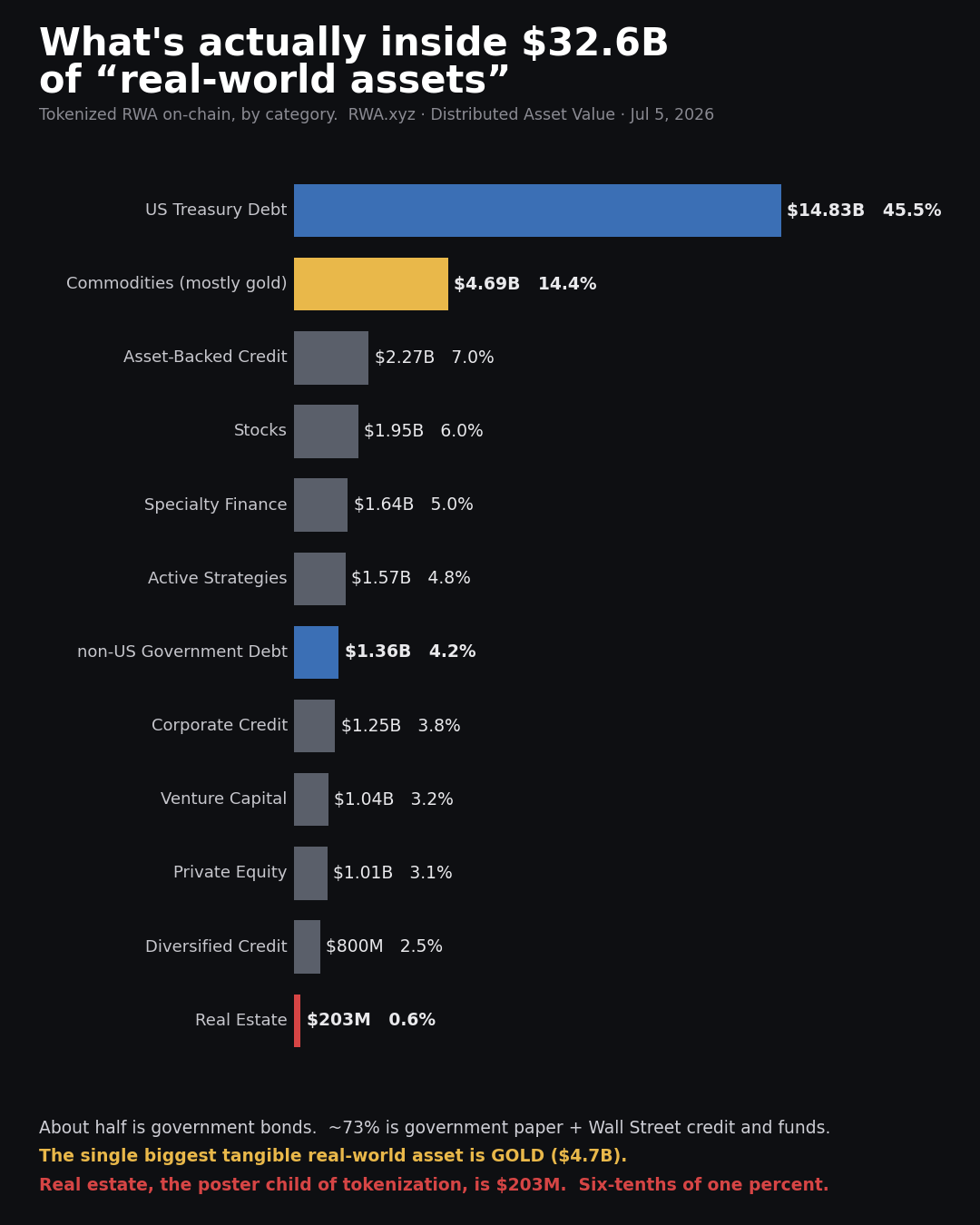
The category list is useful, but the two groupings underneath it are what make the number legible. Both are as of July 5 2026, verify current.
Government paper is about half the market. US Treasury debt at $14.83 billion plus non-US government debt at $1.36 billion is roughly $16.2 billion, which is close to 50% of the $32.62 billion total. One instrument type, sovereign debt, is half of everything called a real-world asset on-chain. When someone tells you the RWA market is worth thirty-odd billion, the honest translation is that about sixteen of those billion are governments borrowing money, wrapped in a token.
Government plus all credit plus active strategies is about three quarters. Take the government paper above, add every credit category (asset-backed credit, corporate credit, diversified credit) and specialty finance, and add active strategies, and you reach roughly $23.7 billion, or about 73% of the market. That is the share of on-chain RWA that is, in plain terms, government debt and financial products: lending, funds, and managed yield. It is Wall Street's balance sheet re-issued on a blockchain. None of it is a physical thing you could stand in front of.
The steelman, stated plainly: this is not a scandal, and these products are not fake. Tokenized Treasuries and on-chain credit are genuinely useful. They give crypto-native capital a dollar-denominated, yield-bearing instrument with real backing, and they work. The critique here is narrow and specific. It is not that the $23.7 billion is bad. It is that calling it real-world assets invites people to picture tokenized farmland and factories, when what they are mostly buying is government debt and credit funds. The money is real. The label oversells what the money is.
For a decade, tokenization was sold to the world through real estate. Split a building into on-chain shares, let anyone own a slice of a New York tower from their phone, unlock trillions in illiquid property. That was the pitch, and it is still the mental image most people carry when they hear tokenized real-world asset.
The data as of July 5 2026 says tokenized real estate is about $203 million, roughly 0.6% of the on-chain total (verify current). It is one of the smallest categories in the entire breakdown. It is smaller than tokenized stocks, smaller than venture capital, smaller than private equity, and a small fraction of commodities. A single mid-sized tokenized Treasury fund can be larger than the whole of on-chain real estate combined.
This gap between the narrative and the number is the single most important fact in the whole breakdown, and it is worth sitting with rather than explaining away. The reason property is tiny is not that the idea was wrong. It is that tokenizing a real, operating asset properly is hard: it needs a real asset, a real special-purpose vehicle, real cash flow, and real legal structure, none of which a marketing deck provides. The easy things to tokenize, government debt and credit, are what filled the number. The hard thing, real productive assets, is what stayed small. That is the whole reason this desk works the asset end rather than the token end, and it is walked through in detail in RWA Roast #16, on why almost none of the $32 billion is a real-world asset.
If the question is simply which category is biggest, the answer is US Treasury debt at $14.83 billion, about 45.5% of the market. Nothing else is close. Treasuries dominate on-chain RWA the way one heavyweight product dominates any new market, because they are the easiest genuinely valuable thing to put on a blockchain: standardised, liquid, safe, and already understood by everyone.
But a Treasury is a claim on government debt, not a tangible object. If the question is which genuinely physical, real, tangible asset is the biggest, the answer changes. It is commodities at $4.69 billion, almost entirely gold, about 14.4% of the market. Gold is the largest real, physical asset that has been meaningfully tokenized, and by a wide margin. It sits second in the whole breakdown, ahead of every credit and fund category.
That is worth naming clearly, because it is the honest version of the good news. Tokenization has genuinely brought one real, tangible, value-storing asset on-chain at scale, and that asset is gold. Everything more real-economy than gold, the buildings and operating assets, drops off fast. The tangible slice of RWA is essentially gold, plus a $203 million sliver of real estate, plus not much else. The rest of the tangible-sounding narrative has not shown up in the data yet.
The reason real productive assets are the smallest slice is that doing it right is not cheap or simple. The full 2026 cost stack, line by line, is in the cost-to-tokenize guide, so you can see exactly why the easy paper filled the number and the hard assets did not.
Read the cost breakdown →The on-chain RWA total is genuinely rising, and past $32 billion it is a serious market by any honest measure. Anyone telling you tokenization is dead is not reading the number. The relevant question is not whether it grows, but which parts grow, because that is what tells you what the market is becoming.
The growth engines are tokenized US Treasuries and on-chain credit. Those are the categories pulling the total up, and for a coherent reason. Crypto-native capital wants dollar-denominated yield it can hold and move on-chain, and Treasuries and credit funds supply exactly that. This is a real product-market fit, not a mirage. The Wall Street part of RWA is growing because it solves a real problem for on-chain capital, and it will likely keep growing.
What is not growing at the same pace is the tokenization of real, productive, real-economy assets: the warehouses, the batteries, the solar installations, the operating businesses. That part stays thin, not because the demand for capital is absent, but because the supply of properly structured deals is. So the market is compounding fastest in the parts that already resemble finance, and staying small in the part where the original RWA promise, and frankly the more interesting opportunity, actually lives. Reading the growth honestly means holding both facts at once: the number is real and rising, and it is rising almost entirely in government debt and credit.
Read the breakdown as an operator rather than a spectator and it inverts. The crowded categories, Treasuries and credit, are crowded because they were easy, and easy markets get competitive fast and compete on basis points. The empty category, real productive assets, is empty because it is hard, and hard markets stay uncrowded for whoever is willing to do the work properly.
That is the position this desk takes. A European business with a real asset that produces real cash flow, a battery-storage site, an industrial building, a solar-trading book, is sitting in the exact part of the chart that the $32.62 billion has barely touched. Tokenizing that asset to raise capital against it is not competing with tokenized Treasuries; it is doing the thing the whole category was named after and mostly skipped. The mechanics of how a business does that, and what the token actually gives an investor a claim to, are the subject of the rest of the guides on this site.
This matters for two different readers. If you run a real-economy business in Europe and need capital, the emptiness of the real-asset slice is not a warning sign, it is open field. If you are an allocator, the same emptiness is why a properly structured real-asset deal is a genuinely different proposition from buying the on-chain equivalent of a government bond fund. Either way, the useful move is the same: stop treating $32.62 billion as one thing, and start asking which slice of it you actually want to be in.
One honest caveat on the data: every figure here is a single-day snapshot from one source, RWA.xyz Distributed Asset Value, on July 5 2026. Different trackers count differently, some include stablecoins or marketed pipeline and land on much larger numbers, and the mix shifts daily as new issuance settles. Treat the composition, half government, roughly three quarters paper, gold as the biggest tangible asset, real estate near zero, as the durable finding, and treat the exact dollar figures as a point-in-time reading to verify against the live source before you quote them.
The $32.62 billion is mostly government debt and credit funds. The part it was named after, a European business tokenizing a real, productive asset to raise capital, is where the desk works, and it is nearly empty. If you run a real-sector business and want to see what raising against your asset actually looks like, a strategy session walks the structure, the cost, and the path to capital. No pitch, no obligation.
As of July 5 2026, about $32.62 billion by Distributed Asset Value on RWA.xyz (verify current, it moves daily). That counts assets actually issued and distributed on public chains, and excludes stablecoins and unissued marketed pipeline. It is a real, growing number, but the label RWA hides that it is mostly government debt and financial paper rather than tokenized productive assets. See section 01.
Financial paper, not physical assets. US Treasury debt alone is about $14.83 billion, roughly 45.5%. Government paper (US plus non-US) is about $16.2 billion, close to half. Government plus all credit plus fund wrappers and active strategies reaches about $23.7 billion, or roughly 73% of everything on-chain. Genuinely tangible assets are a small slice, and the largest of those is gold. See section 02.
About $203 million as of July 5 2026, roughly 0.6% of the $32.62 billion total (verify current). Despite a decade of real-estate-led marketing, property is one of the smallest categories in the actual data, smaller than tokenized stocks and a fraction of a single Treasury fund. The picture most people hold of RWA is close to a rounding error. See section 04.
By category it is US Treasury debt at about $14.83 billion, roughly 45.5%. But a Treasury is a claim on government debt, not a physical thing. The biggest genuinely tangible asset is commodities, almost entirely gold, at about $4.69 billion, roughly 14.4%. Gold is the largest real, physical asset that has been meaningfully tokenized. See section 05.
Yes, but the growth is concentrated in tokenized US Treasuries and on-chain credit, which give crypto-native capital a yield-bearing dollar instrument that genuinely works. What is not growing at the same pace is the tokenization of real, productive real-economy assets, the part the RWA narrative was actually about. The market grows fastest in the parts that already look like Wall Street. See section 06.
This guide is the global category breakdown of the on-chain total by asset type. The separate EU market-size guide answers a different question: inside Europe, how much of the marketed number is actually investable versus announced. One is about what the money is; the other is about how much of it is real supply in one region. See section 01.